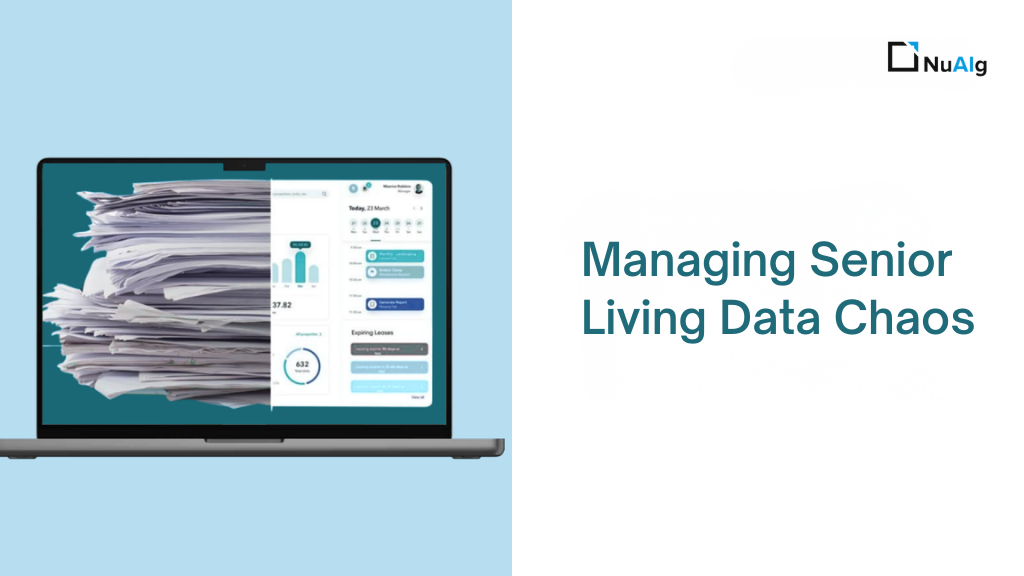
Senior living organizations are not lacking data. They are overwhelmed by it.
Across finance, EHRs, HR platforms, marketing systems, CRMs, and quality reporting tools, operators often rely on 30 to 60 applications to run the business. Each system produces dashboards and reports. Yet executive teams still struggle to answer fundamental questions:
- Are we operating efficiently across communities?
- Where are our biggest financial and staffing risks?
- What needs attention this week, not next month?
This gap between data volume and decision clarity is one of the most pressing operational challenges in senior living today.
The problem is not access to data. The problem is fragmentation, process friction, and the absence of a clear senior living data strategy.
Why Senior Living Data Feels Fragmented and Unmanageable
1. Data Lives in Silos
- Census sits inside the EHR.
- Staffing data lives in HR systems.
- Financial performance lives in accounting software.
- Marketing data often lives in spreadsheets.
Very few systems are designed to communicate seamlessly. Leadership teams are left stitching together insights manually, which leads to inconsistent reporting and limited trust in the numbers.
Without a single source of truth, alignment becomes difficult and accountability becomes unclear.
2. Manual Reporting Consumes High Value Talent
- Finance exports data into Excel every month.
- Admissions re-enters resident information across multiple systems.
- HR reconciles headcount manually across locations.
These swivel-chair workflows drain hours each week. They introduce errors, slow decision cycles, and contribute to burnout in an industry already under workforce pressure.
Technology was meant to reduce work. Instead, it often multiplies it.
3. Reporting Is Reactive Instead of Proactive
Most organizations rely on static monthly reports or PDF summaries. By the time leadership reviews the numbers, the opportunity to act has already passed.
There are limited early warning signals for:
- Occupancy risk
- Staffing instability
- Overtime trends
- Care quality indicators
- Accounts receivable delays
In a margin-sensitive environment, delayed insight directly impacts financial performance.
4. High Impact Workflows Are Slower Than They Should Be
Admissions, onboarding, invoice processing, document management, and accounts receivable often involve dozens of manual steps.
These slow processes affect:
- Cash flow
- Staff morale
- Compliance
- Resident experience
The issue is rarely effort. It is design. Many workflows evolved organically and were never optimized end to end.
5. AI in Senior Living Feels Promising but Risky
Leaders hear daily about copilots, automation tools, and AI assistants. The excitement is real. So is the uncertainty.
Without clean, connected, and reliable data, AI initiatives remain small pilots. They do not scale. They do not transform outcomes.
AI does not fix broken foundations. It amplifies whatever foundation already exists.
What a Strong Senior Living Data Strategy Actually Looks Like
Transformation does not start with buying new tools. It starts with clarity.
A practical senior living data strategy includes:
- A unified data foundation that integrates EHR, HR, finance, CRM, and operational systems
- Real time dashboards tailored for executive, operations, finance, HR, and clinical leaders
- Workflow automation that removes repetitive manual effort
- Clear ownership of metrics and governance standards
- A phased roadmap for automation and AI adoption
This approach reduces noise and increases confidence.
Many senior living providers are at very different stages of data maturity. Some organizations are still heavily manual. Others have dashboards but limited integration across systems. Understanding your current stage is critical before making additional technology investments.
If leadership does not know whether they are operating in a reactive, standardized, integrated, or predictive stage, it becomes difficult to prioritize automation or AI initiatives effectively. Assessing data maturity creates clarity on what should be fixed first and what can responsibly come next.
Check your communities’ data maturity here
How NuAIg Supports Data Integration and Modernization in Senior Living
NuAIg works specifically with senior living providers to solve these challenges without forcing system replacement.
Creating a Single Source of Truth
NuAIg integrates data across EHRs, HR systems, financial platforms, CRMs, and operational tools into a centralized data foundation.
Leadership gains real time, role-based dashboards designed around how senior living actually operates, not generic templates.
For the first time, finance, operations, HR, and executive leadership see the organization as one connected system.
Automating Manual Processes with a Virtual Workforce
Through robotic process automation, NuAIg deploys bots that:
- Extract and reconcile reports
- Log into legacy systems
- Upload and validate documents
- Trigger alerts and workflows
This reduces manual workload without disrupting existing systems. Staff time shifts from repetitive tasks to higher value decision making.
Moving from Reporting to Predictive Insight
Once data is centralized and trusted, analytics become forward-looking.
Providers can identify:
- Staffing instability patterns
- Caregiver attrition trends
- Census risk signals
- Revenue leakage indicators
- Quality measure fluctuations
The shift from reactive reporting to proactive insight changes how leadership plans and prioritizes.
Designing a Realistic AI Roadmap
Rather than chasing trends, NuAIg evaluates operational readiness and data maturity.
The result is a phased roadmap aligned with leadership priorities and compliance realities.
AI becomes a strategic layer, not an experiment.
The Real Outcome: Decision Confidence
In senior living, uncertainty is expensive.
When leaders trust their numbers, decisions accelerate.
When workflows are streamlined, teams stabilize.
When insight is proactive, risks are contained earlier.
The future of senior living is not about collecting more data. It is about designing systems that turn data into confident action.
That transformation begins with strengthening the foundation.