In senior living and aging services organizations, the Chief Financial Officer operates at the intersection of operations, workforce management, and resident care. Beyond managing financial performance, today’s CFOs are increasingly expected to provide strategic insight that helps leadership teams make faster and better decisions.
Yet many finance leaders face a familiar set of challenges:
- Fragmented data
- Manual workflows
- Limited real-time visibility into performance across communities and service lines
As organizations grow more complex, these issues make it difficult for finance teams to evolve from reactive reporting to proactive financial leadership.
Technologies, particularly Artificial Intelligence, Data, and Intelligent Automation, are changing this dynamic. When applied thoughtfully, these tools allow finance teams to move from backward-looking reporting to forward-looking decision support.
The Visibility Problem: Too Many Systems, Not Enough Insight
One of the biggest barriers to financial visibility in senior living is the fragmented technology landscape.
Most providers rely on multiple specialized systems to manage different aspects of operations.
- Clinical information is on EHR platforms like PCC or MatrixCare.
- Financial data lives in accounting systems.
- Workforce data sits in HR platforms.
- Admissions activity is tracked in CRM tools.
Each system performs its specific functions well, but they rarely communicate seamlessly with one another.
For CFOs, this fragmentation creates a major operational burden. Answering seemingly straightforward questions, such as understanding revenue trends across communities or comparing labor costs with occupancy changes often requires pulling reports from several systems and manually compiling them in spreadsheets.
By the time the data is assembled, the opportunity to act on the insight may already have passed.
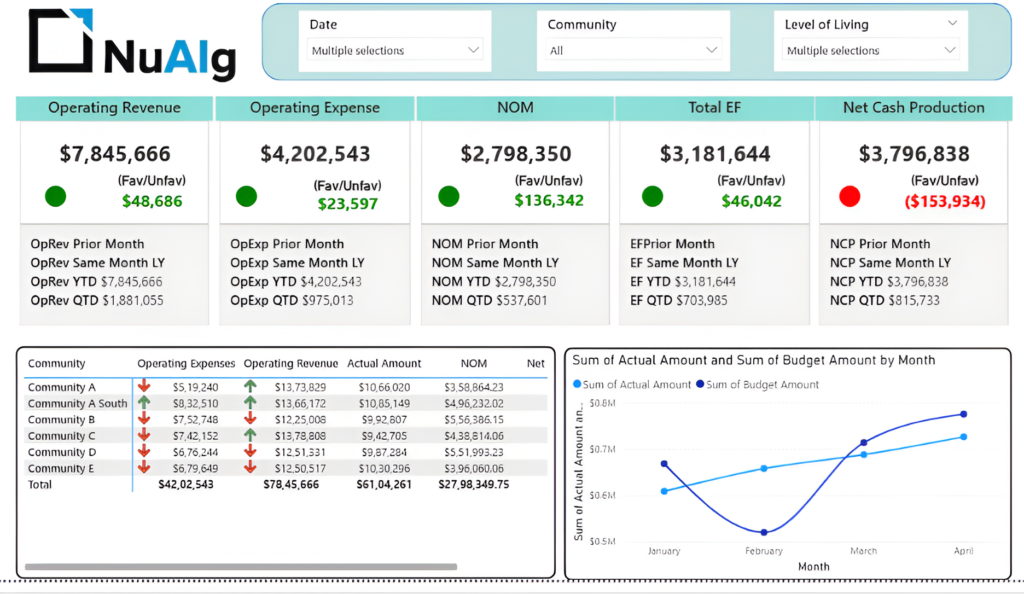
Modern data integration platforms and AI-driven analytics are helping solve this challenge. By bringing data from multiple systems into a unified environment, organizations can create real-time dashboards and dynamic reports that provide leadership teams with a clearer view of performance.
Turning Data into Insight
Access to data alone does not guarantee better decisions.
Many organizations produce a large number of financial reports, but those reports often analyze metrics in isolation rather than presenting a complete view of performance. Occupancy, labor costs, and revenue trends are frequently examined separately; vis-a-vis interconnected drivers of financial outcomes.
Artificial Intelligence helps connect these dots.
AI-powered analytics platforms can analyze operational and financial data together, identifying patterns and correlations that might otherwise go unnoticed.
For example, organizations can better understand:
- How staffing levels influence operating margins
- How resident acuity affects cost structures
- How occupancy trends impact revenue forecasting
By combining operational and financial data in a single analytics environment, CFOs gain a more complete understanding of the factors shaping financial performance.
Moving Beyond Historical Reporting
Traditionally, financial reporting in healthcare and senior living has focused primarily on historical performance, such as the financial performance of last month or last quarter.
While this type of reporting remains essential, it is no longer sufficient in an environment where labor costs fluctuate; regulatory requirements evolve, and resident expectations continue to rise.
Artificial intelligence is beginning to shift finance from retrospective reporting to predictive insight.
With the right data infrastructure in place, AI models can analyze historical patterns and forecast possible outcomes. These predictive capabilities allow organizations to anticipate challenges before they occur.
For example, predictive analytics can help CFOs:
- Forecast labor cost pressures
- Anticipate potential occupancy changes
- Model the financial impact of reimbursement shifts
Instead of reacting to financial pressures after they arise, organizations can plan earlier and make more informed strategic decisions.
Reducing Manual Work in Finance Operations
Another persistent challenge in many finance departments is continued reliance on manual workflows.
Processes such as invoice processing, reconciliation, report generation, and data transfers between systems often involve multiple manual steps. Staff members frequently download information from one system, re-enter it in another, and compile reports manually.
These repetitive tasks consume valuable time and increase the risk of errors and delays. In an industry already facing workforce shortages, inefficient administrative processes add additional strain to finance teams.
Intelligent Automation, including robotic process automation and AI-powered workflows, are helping organizations address these inefficiencies.
By automating repetitive tasks such as invoice data extraction, report generation, or system-to-system data transfers, finance teams can focus more on higher-value work such as analysis, forecasting, and strategic planning.
Building a More Connected Financial Ecosystem
For many senior living organizations, building a modern, AI-enabled finance environment requires specialized expertise.
Technology partners can help connect existing systems, establish a reliable data foundation, and introduce automation where it delivers the greatest operational value.
Importantly, many successful initiatives focus not on replacing existing platforms, but on unlocking the value of data already stored within them.
Through data integration, automation, and advanced analytics, organizations can create a more connected financial ecosystem. Interactive dashboards provide real-time performance metrics; automated workflows reduce administrative burden, and AI-driven analytics surface insights that support better strategic decisions.
A Strategic Opportunity for CFOs
For finance leaders, adopting data, automation, and AI technologies represents more than a technology upgrade. It offers an opportunity to elevate the role of finance within the organization.
When financial insights are timely, integrated, and forward-looking, CFOs can become strategic advisors who guide decisions around operations, workforce planning, and organizational growth.
In an industry facing increasing complexity, the organizations that succeed will likely be those that combine strong financial leadership with modern data capabilities.
For CFOs in senior living, the path toward better financial visibility may begin with technology, but its ultimate impact is a more informed, data-driven organization.
If you’re wondering where these solutions could make the biggest impact in your community, that’s exactly where we come in.
We’ll help you assess your current state, identify quick wins you can act on immediately, and map out a clear, practical 3-year roadmap tailored to your goals.
Start the conversation at info@nuaig.ai and let’s turn potential into progress.