Most senior living communities are already stretched thin. They are juggling staffing shortages, rising resident expectations, documentation overload, and constant operational pressure.
At the same time, AI is becoming part of everyday conversations across healthcare and senior living.
Staffing shortages and turnover continue to pressure senior living operators across the US, making efficiency and workforce support more important than ever.
The opportunity is real. AI can reduce time spent on repetitive tasks, improve communication, and help surface early care risks faster. But none of that matters if your frontline staff does not feel confident using it.
That is where many communities get stuck.
The Human Side of AI Adoption in Senior Living
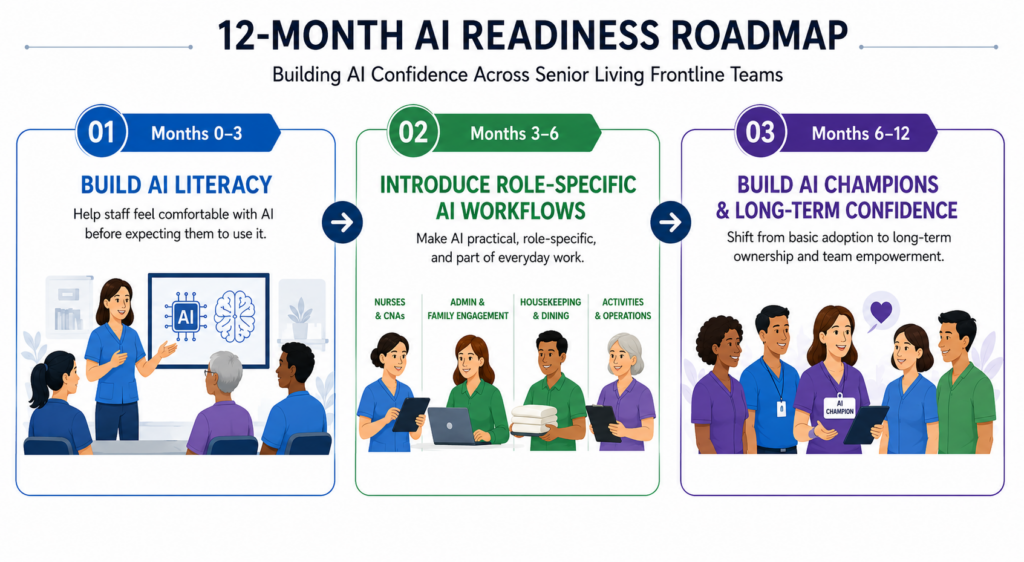
Phase 1: Build AI Literacy (Months 0–3)
The first step is helping staff feel comfortable with AI before expecting them to use it.
For many frontline employees, especially long-time caregivers and operational staff, AI can feel unfamiliar or intimidating. Starting with complex tools too early usually creates resistance instead of adoption.
Keep the first phase simple and practical.
Run short training sessions focused on everyday examples staff can relate to:
- What AI is and what it is not
- Why human oversight still matters
- Privacy and bias risks
- Simple ways AI can support daily work
Show examples that feel relevant to senior living operations. For example:
- Drafting a family update
- Summarizing care-plan notes
- Identifying possible fall-risk patterns
- Reducing repetitive documentation work
Making AI More Accessible for Senior Living Staff
Hands-on demonstrations work better than long presentations. Use devices and systems that staff already interact with daily. This will help AI feel like part of the workflow instead of another complicated platform being introduced from the top down.
One simple but effective approach is creating a one-page AI basics cheat sheet after each session. Something staff can quickly refer to during shifts or keep near workstations.
At this stage, success is not about advanced usage. It is about reducing hesitation and building familiarity.
Phase 2: Introduce Role-Specific AI Workflows (Months 3–6)
Once staff understand the “why,” they become more open to learning the “how.”
This is where AI adoption becomes more practical and role-specific.
For nurses and CNAs, AI can support documentation workflows by helping organize shift notes, care-plan updates, and resident observations into clearer, more consistent records.
For administrative and family engagement teams, AI can reduce time spent writing updates, reports, and communication emails.
Operational departments such as housekeeping, dining, and activities can also benefit from AI-assisted scheduling tools, checklists, and workflow prioritization.
The key is to avoid rolling everything out at once.
AI Training That Works for Senior Living Teams
Start with one unit, one tool, and just one use case.
Run a small pilot for two to three weeks. Train the team, gather feedback, and identify where staff still feel friction or confusion.
After the pilot, hold a short lessons-learned huddle. These conversations often surface practical insights leadership teams would otherwise miss.
AI adoption improves significantly when staff feel included in the process rather than feeling like technology is simply being pushed onto them.
Phase 3: Build AI Champions and Long-Term Confidence (Months 6–12)
After six months, communities should start shifting from basic adoption to long-term ownership.
One of the most effective ways to do this is by identifying AI champions within each unit.
These do not need to be technical experts. In many cases, the best AI champions are simply team members who are curious, approachable, and willing to help others learn.
AI champions can:
- Help answer day-to-day questions
- Share useful prompts and shortcuts
- Identify workflow improvements
- Support new staff during onboarding
This becomes especially important in senior living environments where turnover and staffing shortages can make repeat training difficult.
Building AI Confidence Across Senior Living Teams
The communities can offer optional advanced learning sessions for staff who want to build greater skills. Topics may include writing better prompts, reviewing AI-generated summaries, or understanding when certain alerts should be escalated to leadership or clinical teams.
Over time, AI should begin to feel less like a special initiative and more like another operational tool staff use naturally throughout the day.
Measuring Whether Upskilling Is Working
Training only matters if it improves outcomes.
Communities should track a few simple metrics throughout the process:
- Staff confidence scores before and after training
- Time saved on documentation and communication tasks
- Weekly adoption rates
- Feedback from frontline teams
The goal is not perfect adoption overnight.
The goal is creating a culture where staff feel supported by AI instead of overwhelmed by it.
Because in senior living, technology only creates value when the people using it trust it enough to make it part of care.
Final Thoughts
AI adoption works best when staff feel included, supported, and confident in how the technology fits into their daily workflows.
At NuAIg, we work with senior living organizations to identify practical AI use cases, support workflow adoption, and conduct hands-on workshops designed for operational and frontline teams.
Whether you are exploring AI for documentation, family communication, or workforce efficiency, the goal is not to replace staff. It is to help teams spend more time on care and less time on repetitive tasks.