Artificial Intelligence has become a constant theme in senior living leadership discussions. From conferences to boardrooms, “AI agents or Copilots” are increasingly positioned as the next frontier. They are capable of transforming operations, improving resident experience, and reducing staff burden.
But beneath the excitement lies a more nuanced reality.
Across conversations with senior living providers, one thing is clear: AI agents are not being adopted as a sweeping transformation. They are emerging quietly, through specific, practical use cases.
This blog separates the hype from what’s actually working.
The Hype: AI Agents as a Silver Bullet
In theory, AI agents promise a lot.
They can:
- Act as virtual concierges for resident
- Automate workflows across departments
- Replace repetitive administrative tasks
- Provide real-time insights and recommendations
For an industry facing staffing shortages, rising costs, and increasing expectations from residents, this vision is compelling.
But in practice, most organizations are not starting here.
In fact, many are still grappling with more fundamental challenges:
- Data scattered across multiple systems
- Limited visibility into key operational metrics
- Heavy reliance on manual processes and Excel
- Inconsistent adoption of dashboards and reporting tools
Before AI agents can deliver value, these foundational gaps need to be addressed.
The Reality: AI Agents Are Entering Through Narrow Use Cases
Rather than large-scale deployments, AI agents are gaining traction in focused, high-friction areas of operations.
Register for our webinar – AI in Senior Living : Insights from the Early Adopters for to know more!
Here are some of the most relevant real-world use cases emerging today:
1. Concierge and Resident Query Agents
One of the most promising applications is at the front desk.
In many communities, staff spend significant time answering repetitive questions:
- Billing queries
- Policy clarifications
- Service-related information
Today, this often involves:
- Checking multiple systems
- Following up with back-office teams
- Getting back to residents later
AI agents are starting to change this.
By aggregating organizational knowledge, including policies, documents, and data, these AI agents and Copilots can provide instant, accurate responses to common queries. This reduces wait times for residents and frees up staff for more meaningful interactions.
2. Voice-Based Check-ins and Surveys
Another area gaining traction is Voice AI agents.
Traditionally, resident and employee surveys are:
- Time-consuming
- Expensive (often outsourced)
- Infrequent
AI-powered voice agents can:
- Conduct check-ins with residents
- Gather feedback in a natural, conversational way
- Automatically analyze responses
Some providers are already exploring these agents for:
- Daily wellness check-ins
- Employee engagement surveys
- Family communication touchpoints
This is one of the first areas where AI feels both human and scalable.
3. Workflow Agents for Back-Office Tasks
Behind the scenes, AI agents are evolving from traditional automation.
While Robotic Process Automation (RPA) handles rule-based tasks, agents add a layer of intelligence.
Examples include:
- Following up on outstanding payments
- Assisting with contract reviews
- Supporting incident analysis by identifying patterns
These are not fully autonomous systems yet but are augmenting staff’s decision-making in meaningful ways.
4. Admissions and Onboarding Support
Admissions remain one of the most complex workflows in senior living.
It involves:
- Intake forms
- Document collection
- Financial verification
- System updates
AI agents can assist by:
- Extracting key information from documents
- Triggering next steps automatically
- Ensuring data flows into the right systems
This reduces delays and creates a smoother experience for both staff and incoming residents.
Why AI Agents Aren’t Scaling Faster
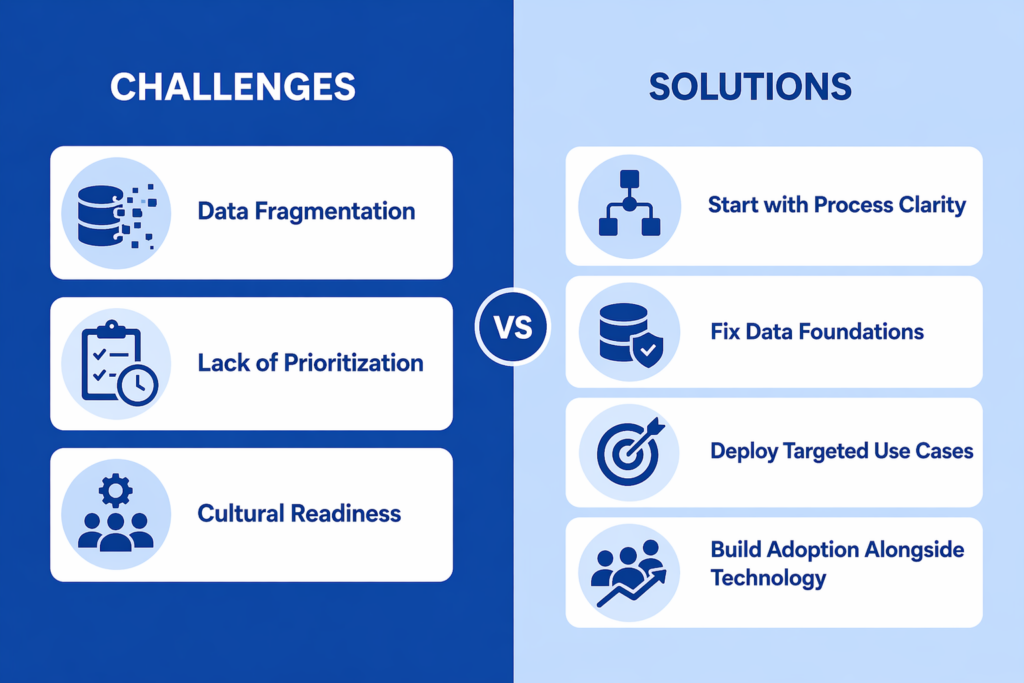
If the use cases are compelling, why isn’t adoption accelerating faster? The answer lies in three consistent barriers:
1. Data Fragmentation
Most providers operate with 40–60 different systems.
Without unified data:
- Agents lack context
- Responses become unreliable
- Automation breaks down
AI agents are only as effective as the data they can access.
2. Lack of Prioritization
Leadership teams are often unsure where to start:
- Should we invest in new systems?
- Fix existing processes?
- Build dashboards?
- Explore AI?
This leads to stalled initiatives and delayed adoption.
3. Cultural Readiness
Even when tools are available, adoption is uneven.
- Dashboards go unused.
- Processes remain unchanged.
- Teams revert to familiar ways of working.
AI agents introduce a new way of interacting with technology, and that requires behavioral change, not just technical implementation.
What Leading Organizations Are Doing Differently
Organizations making progress with AI agents are not chasing hype. They are taking a structured approach:
- Start with process clarity
Identify where time is being wasted or friction exists. - Fix data foundations
Ensure key data is accessible and reliable. - Deploy targeted use cases
Focus on 1–2 high-impact areas rather than enterprise-wide rollouts. - Build adoption alongside technology
Reinforce usage through leadership and workflows.
From Hype to Value
AI agents will play a significant role in the future of senior living.
But their impact will not come from ambitious, large-scale transformations.
It will come from solving small, real problems, repeatedly, and effectively.
The organizations that succeed will not be the ones that adopt AI first.
They will be the ones that:
- Understand their operations deeply
- Prioritize the right use cases
- Build the right foundations
Because in senior living, as in most industries, AI is not a starting point; it is an amplifier.