In our previous blog on financial visibility, we explored how disconnected systems, fragmented reporting, and siloed data limit decision-making for senior living CFOs. We discussed why many organizations are moving toward more integrated, real-time financial visibility across operations.
But visibility alone is no longer enough.
Senior living CFOs are now navigating an environment shaped by workforce instability, rising operating costs, reimbursement pressure, margin compression, and increasing expectations from boards and executive teams. Finance leaders are no longer responsible only for reporting the numbers. They are expected to help guide operational strategy, workforce planning, capital allocation, and long-term organizational resilience.
As the industry continues to evolve, the CFO role is becoming more strategic, more operational, and significantly more complex.
Key Takeaways
- Senior living CFOs are balancing labor pressure, margin compression, and operational complexity simultaneously.
- Financial visibility alone is no longer enough without predictive insight.
- Workforce instability has become a major financial risk.
- Automation and integrated reporting are becoming essential for finance teams.
- Predictive planning is shaping the future of senior living finance leadership.
The CFO Role Is Expanding Beyond Finance
Historically, CFOs in senior living focused primarily on budgeting, reporting, and financial controls. Those responsibilities remain essential, but the scope of leadership has expanded considerably.
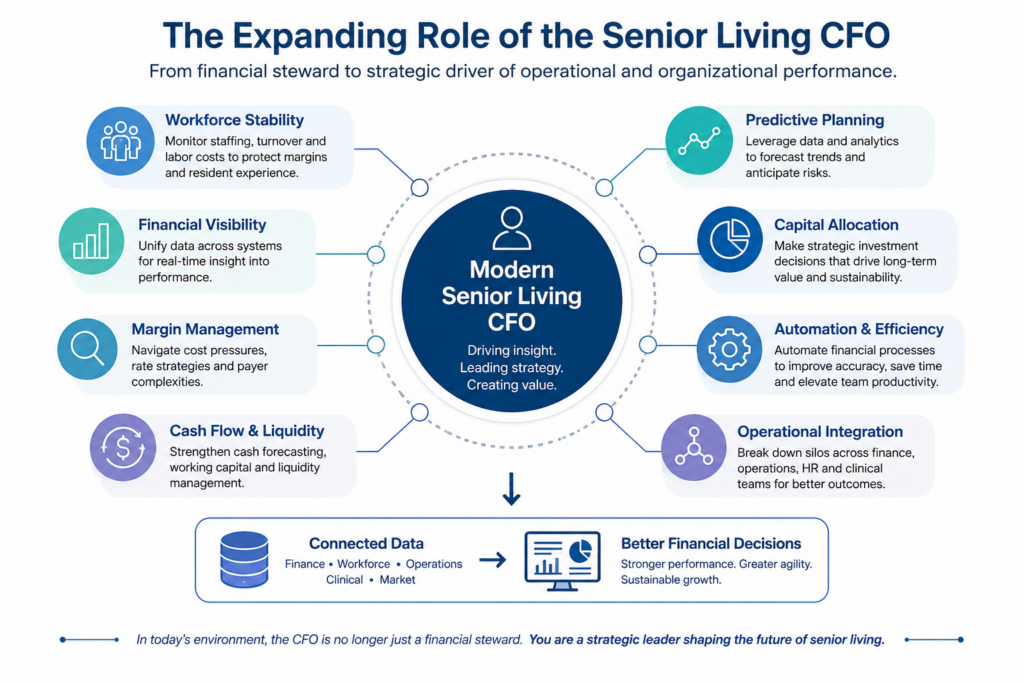
Today’s finance leaders are increasingly involved in labor planning, operational efficiency, technology modernization, and enterprise-wide strategy. In many organizations, the CFO now sits at the center of major operational decisions because nearly every challenge eventually impacts financial performance.
Organizations that perform well over the next several years will likely be those that connect finance, workforce data, operations, and strategic planning into a more coordinated decision-making framework.
Workforce Instability Has Become a Financial Issue
Labor continues to be one of the biggest pressures facing senior living organizations. Staffing shortages, turnover, overtime, and contract labor directly affect operating margins, resident experience, and operational consistency.
For CFOs, the challenge is not simply understanding labor spend. The larger issue is identifying where workforce instability is creating downstream operational and financial risk.
Questions finance leaders increasingly need to answer include:
- Which communities are experiencing the highest turnover?
- Where is agency utilization driving avoidable costs?
- How are staffing patterns impacting resident satisfaction and occupancy?
- Which labor trends are creating long-term margin pressure?
Many organizations already possess this data across HR systems, payroll platforms, scheduling tools, and operational systems. The challenge is that these systems often operate independently, making it difficult to understand how workforce trends influence broader financial performance.
Leading providers are beginning to integrate workforce and operational data into unified reporting environments that provide finance leaders with a clearer view of organizational performance.
Margin Compression Continues Despite Occupancy Recovery
While occupancy levels have improved across many markets, margin pressure remains significant.
Wage inflation, insurance costs, food expenses, compliance requirements, and rising resident acuity continue to impact operating performance. In many cases, revenue growth has not kept pace with expense growth.
This creates difficult decisions for CFOs.
Rate increases may help preserve margin, but aggressive pricing strategies can impact occupancy, competitiveness, and resident trust. At the same time, delaying pricing adjustments may weaken long-term financial sustainability.
As a result, pricing strategies are becoming more localized and community-specific rather than portfolio-wide decisions. Finance leaders increasingly need visibility into occupancy trends, care intensity, market conditions, and resident economics at a granular level.
Cash Flow and Liquidity Require Closer Oversight
In today’s environment, profitability alone is not enough. Liquidity management has become equally important.
Occupancy fluctuations, slower collections, capital spending, and labor volatility can quickly place pressure on cash flow, particularly for organizations operating across multiple communities.
For CFOs, this means greater focus on:
- Cash forecasting
- Working capital management
- Debt service planning
- Covenant monitoring
- Capital prioritization
Even modest underperformance across a handful of communities can create meaningful financial pressure at the organizational level. That makes real-time operational visibility increasingly important for finance teams.
Capital Allocation Is Becoming More Strategic
Capital allocation decisions are becoming increasingly complex for senior living operators.
Finance leaders must evaluate where to invest, where to delay spending, which communities require turnaround support, and which assets may no longer align with long-term organizational goals.
Not every community within a portfolio operates with the same occupancy profile, margin structure, or growth potential. CFOs increasingly need better operational and financial intelligence to guide investment decisions with greater confidence.
This includes evaluating:
- Occupancy potential
- Labor sustainability
- Resident acuity trends
- Deferred maintenance risk
- Technology modernization priorities
- Market competitiveness
In many organizations, capital planning is now a board-level strategic discussion rather than a purely financial exercise.
Operational Fragmentation Still Limits Decision-Making
One of the biggest barriers to effective financial leadership remains organizational fragmentation.
Finance, HR, operations, clinical leadership, and marketing teams often rely on separate systems, separate reporting structures, and different performance metrics. This makes it difficult to build a unified view of organizational health.
When teams operate in silos, leadership loses visibility into how staffing, occupancy, resident experience, and financial performance influence one another.
Many senior living providers already have access to substantial amounts of data. The challenge is not the absence of information. The challenge is creating connected, actionable insight across departments.
Manual Finance Processes Still Consume Valuable Time
Many finance teams continue to rely heavily on spreadsheets, emails, and manual reconciliation processes for reporting and operational workflows.
These manual processes slow decision-making, increase the risk of errors, and reduce the amount of time finance teams can spend on strategic analysis.
Automation is helping organizations streamline functions such as:
- Accounts payable
- Invoice processing
- Reconciliation
- Reporting workflows
- Data transfers between systems
The value of automation is not simply operational efficiency. It allows finance teams to spend more time on forecasting, planning, and strategic support for leadership.
Predictive Planning Is Becoming Essential
Traditional financial reporting has historically focused on historical performance. That approach is becoming increasingly insufficient in an industry shaped by labor volatility, reimbursement changes, and pricing sensitivity.
Finance leaders increasingly need predictive insight rather than retrospective reporting.
Organizations are beginning to explore analytics environments that can help forecast:
- Labor cost trends
- Occupancy shifts
- Cash flow pressure
- Turnover risk
- Revenue fluctuations
The goal is not replacing financial judgment. It is enabling leadership teams to identify risks earlier and make more proactive decisions.
Technology Alone Is Not the Strategy
Technology modernization is important, but software alone will not solve these challenges.
Many organizations already have numerous systems in place. The larger issue is often governance, process alignment, and organizational discipline around data and performance management.
Successful transformation requires:
- Cross-functional alignment
- Clear ownership of metrics
- Reliable data governance
- Leadership commitment
- Operational accountability
Technology should support stronger financial decision-making, not complicate it further.
For senior living CFOs, the next phase of leadership is not simply about managing costs. It is about helping organizations build a more connected, resilient, and data-informed operating model for the future.