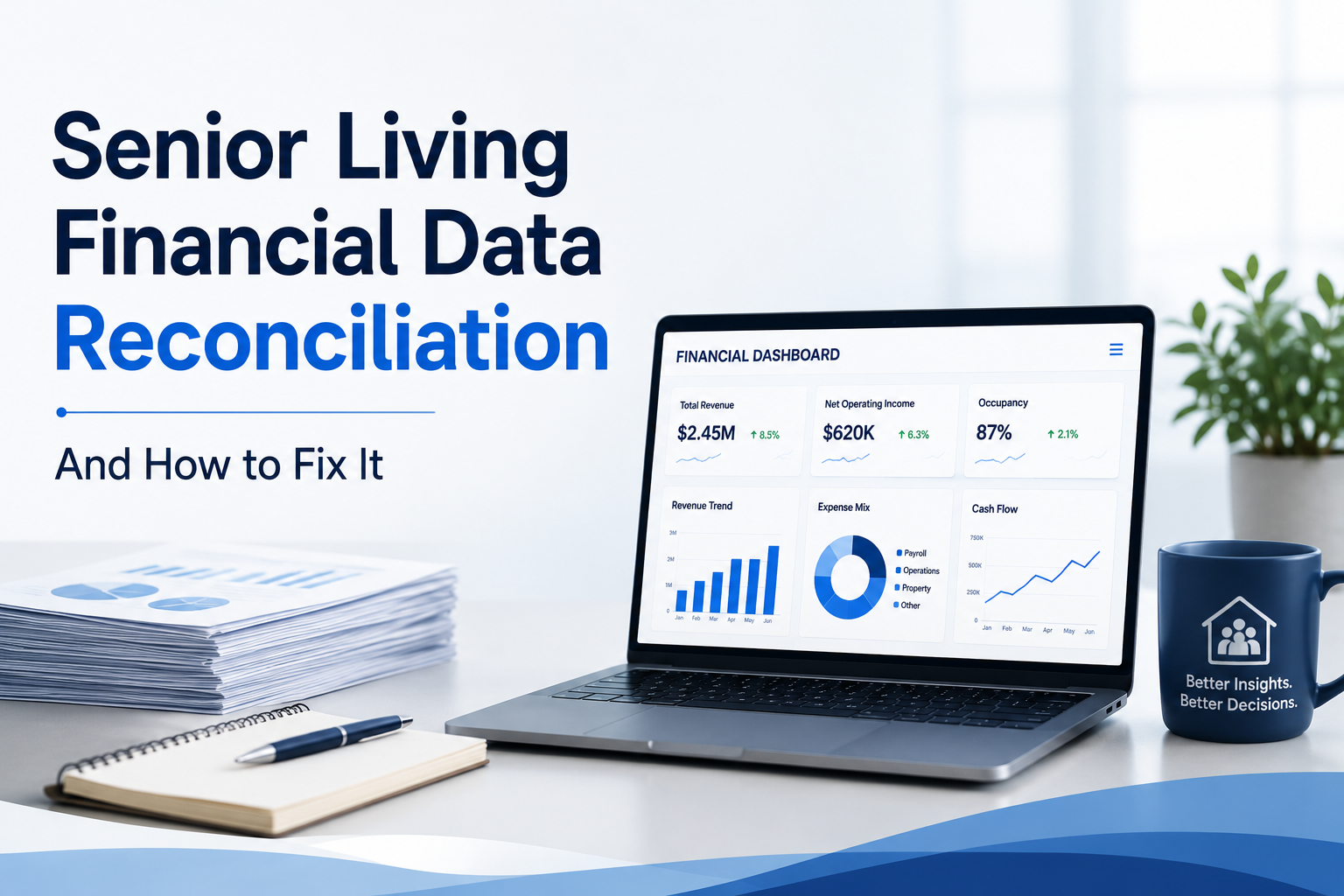
Every senior living finance team knows this month-end ritual: pull the occupancy numbers from one system, the billing numbers from another, reconcile them by hand, and hope the totals land close enough to explain the gap in a footnote. Then someone renames a tab or moves a file, a formula breaks, and now there are three “final” versions of the same spreadsheet circulating by email, each with a slightly different number.
This isn’t a minor annoyance. For CFOs managing multi-community organizations, it’s the daily reality behind board decks that take days to assemble and financial reports that never quite reconcile across systems. And it’s exactly the kind of problem that never gets funded, because “our spreadsheets are a mess” doesn’t sound like a capital request. It sounds like a complaint.
The fix isn’t a better complaint. It’s translating the mess into the same language the board already uses for every other budget line: dollars, hours, and risk.
Name the actual cost of the chaos
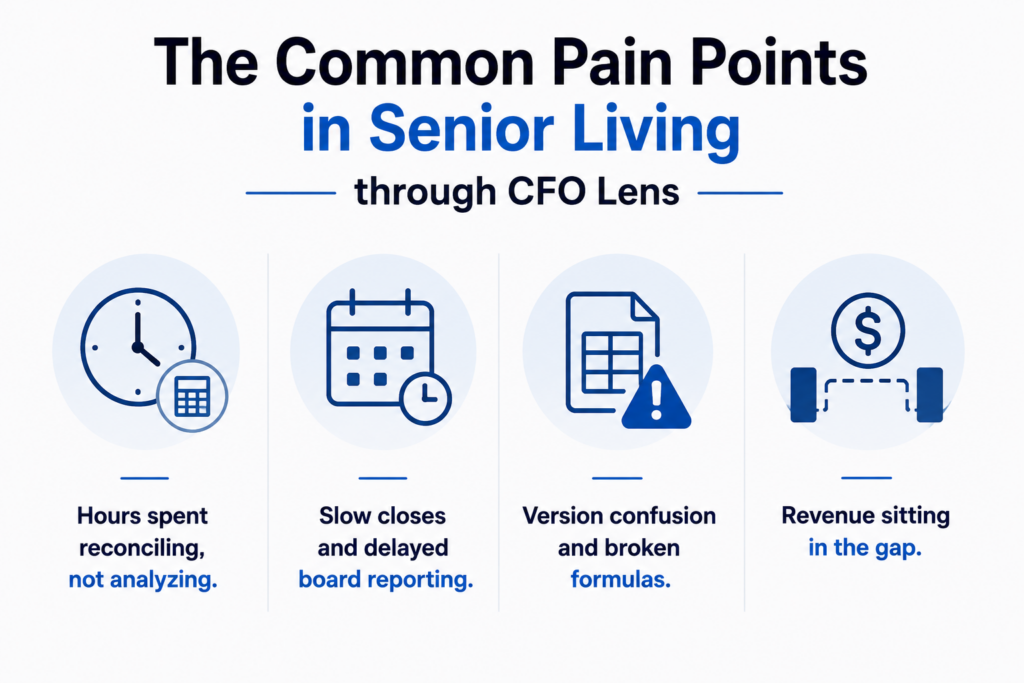
Get specific about where the pain shows up:
- Hours spent reconciling, not analyzing. Track how much time finance, ops, and admissions spend each month cross-checking numbers between EHR, billing, HR, and CRM systems by hand. For most operators, this is the single biggest and easiest-to-explain cost.
- Slow closes and delayed board reporting. If assembling a board deck takes two people several days because the source data lives in disconnected spreadsheets, that’s a direct, measurable drag on leadership’s ability to see and act on problems early.
- Version confusion and broken formulas. Every community running its own workbook, in its own format, with its own quirks, means consolidating a portfolio view can take weeks and still leave leadership unsure which numbers are actually current.
- Revenue sitting in the gap. Missed charge capture and billing delays that happen specifically because census data doesn’t move cleanly from the EHR into billing.
This is where most operators discover the problem was never the systems themselves. It’s that EHR, billing, HR, and CRM platforms were never actually connected into one source of truth. NuAIg’s Data Strategy and Services work exists specifically for this: unifying data that’s currently scattered across systems into dashboards and reporting leadership can actually trust, without ripping out the systems teams already know.
Translate the diagnosis into a dollar-and-timeline case
Once these are quantified instead of just felt, the business case writes itself:
- What does the current state cost per month, in hours and in leaked or delayed revenue.
- What does a fixed version cost to build, and over what timeframe.
- What’s the payback period, and what continues to save money after that.
This is also where the request stops competing with staffing and clinical priorities and starts supporting them. A finance team that isn’t burning a week on reconciliation every month can spend that time on forecasting instead. Much of that reconciliation work is also repetitive enough to automate outright. This is where Intelligent Automation comes in: bots that handle the manual, repetitive parts of billing, compliance, and reporting so staff aren’t doing by hand what a workflow can do overnight.
It’s also the foundation everything else depends on: AI-driven staffing predictions or resident risk flagging only work on data that’s already clean and connected, so this isn’t a one-off fix, it’s the platform later initiatives sit on.
There’s a risk dimension too. IBM’s 2026 Cost of a Data Breach Report puts the average healthcare breach at $6.64 million, the highest of any industry. That’s not a reason to panic, but it’s a real number to weigh against the cost of governance and integration work now versus a scramble after an incident.
Bring evidence, not just a request
Boards approve what they can see. A heat-map showing exactly where the reconciliation hours and dollar leaks are, tied to specific workflows like admissions, billing, or month-end close, is far more persuasive than a general appeal to “we need better data.” This is the same diagnostic approach behind NuAIg’s AI & Digital Enablement Sprint: a short, structured assessment that turns “our spreadsheets are a mess” into a prioritized, dollar-figure roadmap a board can actually approve, typically in a matter of weeks rather than months.
The organizations that get this funded aren’t the ones with the best story about their pain. They’re the ones that showed up with a number.