Most AI failures in senior living are not technology failures. They are culture failures.
This is one of the core insights NuAIg has developed through years of advising senior living and aging services organizations on AI adoption. It came up again sharply in our recent webinar on building AI-ready organizations, and the more you sit with it, the harder it is to argue with. If you want to hear directly from our expert on what this looks like on the ground, watch the full webinar here.
Every year, senior living operators write vendor checks, sign software contracts, and watch those tools quietly collect dust. The technology wasn’t broken. The workflows were. The buy-in was missing. The staff didn’t understand why anything had changed. Leadership assumed the implementation was someone else’s project. Sound familiar?
This is the conversation the industry needs to have before it talks about any specific AI tool.
The demographic reality is not abstract anymore
By 2034, the total population of adults 65 and older in the United States will surpass the total population of children under 17. More than 4.1 million Americans are turning 65 every year. And to meet the housing demand this creates, the industry would need an additional 806,000 senior housing units by 2030.
The residents arriving at your doors tomorrow are not the same residents you built your processes for. They are digitally fluent, financially sophisticated, and accustomed to consumer-grade experiences. The gap between what they expect and what most communities currently deliver is widening fast.
Running legacy workflows against this incoming wave is not just inefficient. It is a strategic risk.
What AI-ready actually means
Here is where most of the industry conversation goes sideways. When operators talk about AI readiness, they jump immediately to tools, software demos, and vendor negotiations. But organizational readiness is the prerequisite that nobody wants to do the work on.
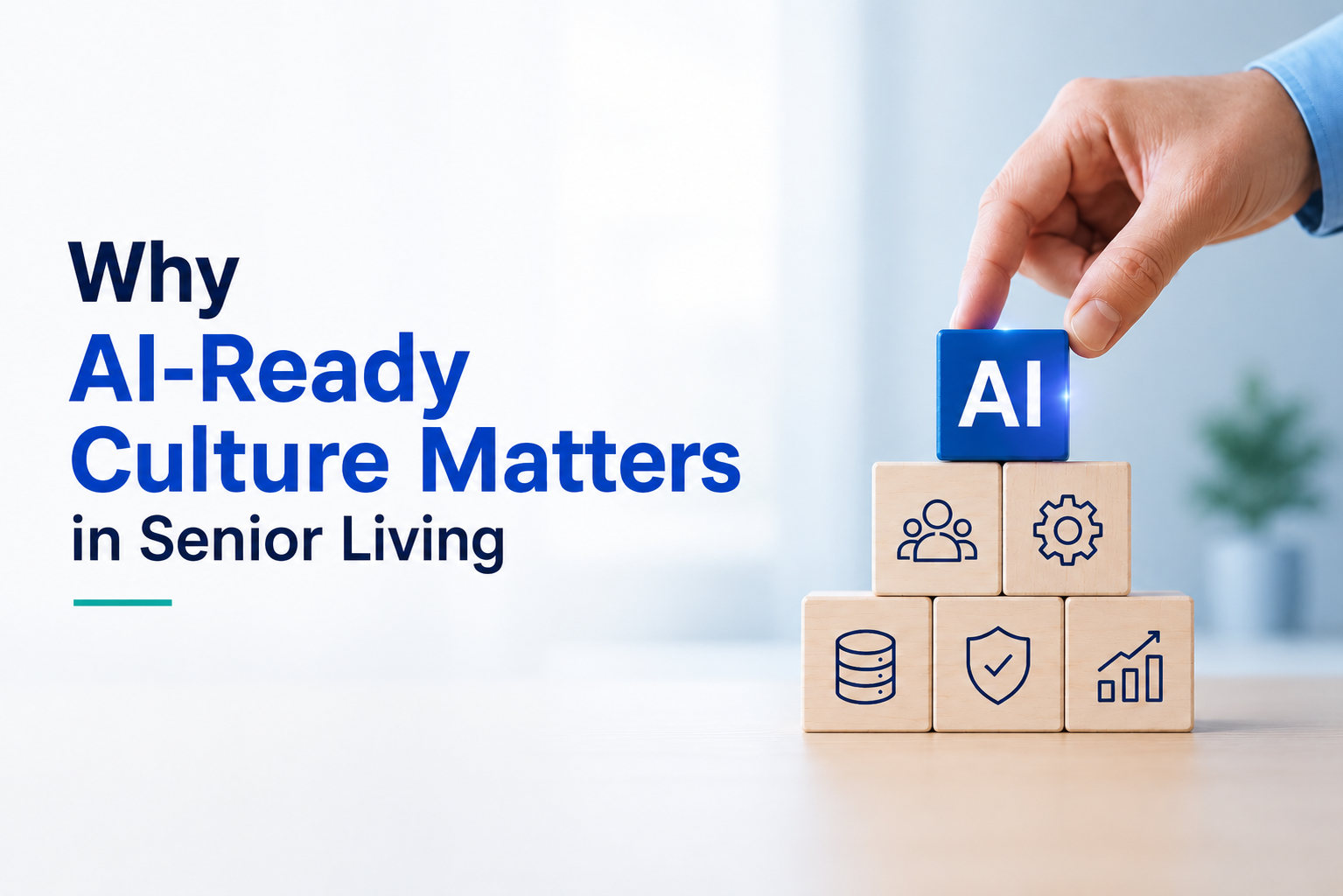
An AI-ready organization is built on five pillars, and removing any one of them makes the rest unstable.
Leadership alignment is the foundation of AI readiness. Many senior living communities do not have a dedicated CIO or internal technology function. Even those that do have someone managing software licenses and keeping systems running, not developing a three-year AI roadmap. Real alignment means every level of the organization, from the C-suite down to floor supervisors, understands why AI matters to the mission and what success looks like. It means an executive who actively owns the initiative, not just approves the budget.
Workforce readiness is where most initiatives stall. Department heads are already stretched. A director of nursing handling daily care operations cannot absorb a vague directive to “get the team ready for AI.” This requires carving out intentional time, identifying internal champions who can serve as process leads and cultural bridges, and treating the initiative as a dedicated project rather than an add-on task.
Operational readiness is the one most operators underestimate. AI is a powerful accelerator, but accelerating a broken process creates faster chaos, not better outcomes. Before any tool goes live, organizations need to map their workflows, from resident intake to shift handoffs to billing cycles, document the actual steps, and identify where the real bottlenecks sit. Then comes the integration audit: do your EHR, CRM, and scheduling systems talk to each other? In NuAIg’s experience, roughly 90% of senior living providers are running on systems that don’t.
Data readiness is the most quietly damaging gap. AI runs on clean data. Most providers don’t have a clear picture of what data they collect, where it lives, or whether it’s structured in any usable way. Fragmented data spread across binders, Excel sheets, and disconnected EHR modules is the leading reason AI pilots fail.
Governance and trust rounds out the framework. Without defined accountability, AI adoption creates compliance and liability exposure. Who owns an AI-driven decision? What oversight exists when that decision influences clinical or financial outcomes? Trust with residents and families is also part of this, and it needs to be established before something goes wrong, not after.
The crawl-walk-run framework keeps this from being overwhelming
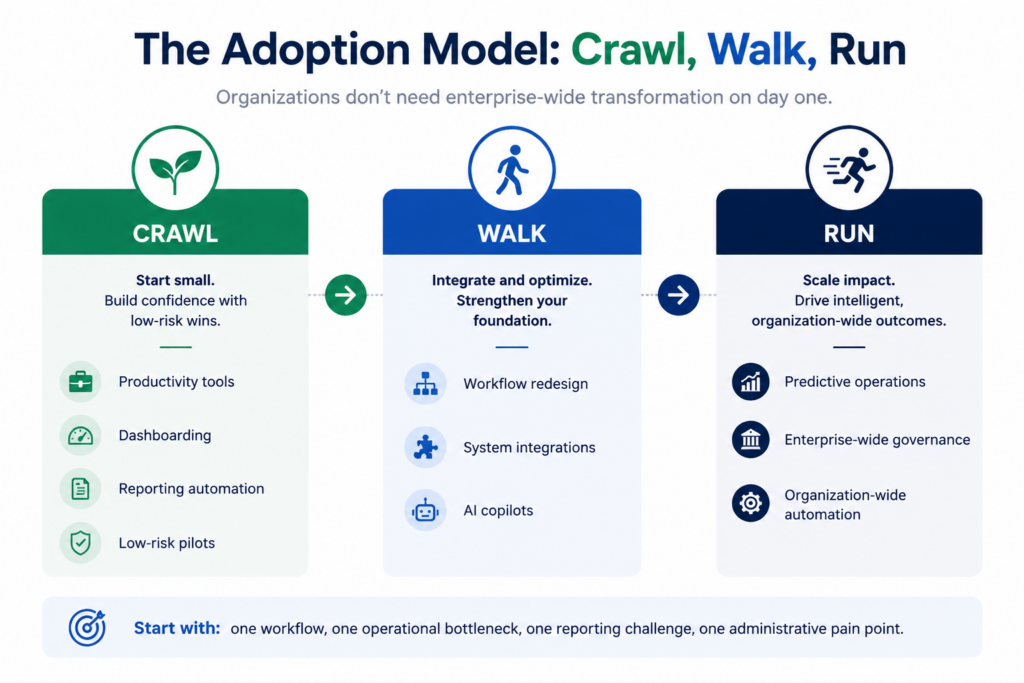
None of this has to happen all at once. NuAIg advises communities to use a disciplined crawl-walk-run approach. Start with basic productivity tools and low-risk pilots, like automating board reporting from an existing Excel. Build confidence. Then move into redesigning workflows and connecting systems that should already be talking to each other. Only once that foundation is solid do you move into advanced automation and predictive operations.
The rule of thumb: “start with one workflow, one bottleneck, one administrative pain point.”
A caregiver today can spend enormous portions of their shift logging into four different systems to check a single update. Ambient clinical documentation tools can cut that administrative burden by 50%, giving staff back the time they got into care work to spend in the first place.
AI transformation is not a project with a completion date. It is a continuous operational evolution, driven by leadership, culture, and trust built incrementally over time.