Six months ago, everything looked good. Leadership was aligned, staff went through training, the pilot launched smoothly, and the case studies practically wrote themselves. Then you check the usage numbers today and something has quietly gone wrong. The dashboard nobody opens anymore. The AI scheduling tool half the team reverted away from. The champion who was so excited during rollout, now too busy to bring it up in meetings.
This is the part of AI adoption in senior living that nobody plans for: what happens after go-live.
Why Does AI Adoption Fail After a Strong Start?
The drop-off rarely looks dramatic. Nobody announces they’ve stopped using the tool. It happens in small moments: a staff member reverting to the old spreadsheet because it’s faster today, a supervisor who never quite followed up on whether the team adopted the new workflow, a champion who moved departments and nobody replaced them.
This isn’t unique to senior living. Across healthcare broadly, research is showing the same pattern. Recent industry surveys have found that most healthcare workers still need additional training to use AI tools effectively in daily workflows, and that leadership change management, not the technology itself, is one of the biggest barriers to adoption sticking long term. In other words, the tool almost never fails. The follow-through does.
A few patterns show up again and again in senior living communities specifically:
The champion vanishes. Every successful rollout has one or two people who carried the enthusiasm. When they get pulled into other priorities, or leave the organization, adoption often leaves with them. Without a clear successor, the tool quietly becomes optional again.
Early wins aren’t reinforced. A team sees a good result in week two, but nobody names it out loud. Recognition matters more than most leaders assume. If staff don’t hear that the new workflow actually helped, they stop trusting that it will keep helping.
The tool drifts from the workflow. Systems change, census patterns shift, new hires join without proper onboarding to the tool. Slowly, the AI system stops matching how the team actually works day to day, and staff quietly build workarounds instead of using it as intended.
Leadership stops asking. Once the initial rollout is “done,” it drops off leadership’s radar. Nobody is checking usage data or asking frontline staff how it’s actually going. Silence gets mistaken for success, until the numbers say otherwise.
How Long Should It Take for AI Adoption to Stick?
There’s no single answer, but a useful rule of thumb from our own work with senior living organizations: early usage often looks strong for the first 30 days simply because of novelty and training momentum. The real test comes around the 90-day mark, once the excitement fades and staff fall back into whatever is easiest under daily pressure. If a tool is still being used consistently at 90 days, it usually sticks. If it isn’t, it’s already fading and needs intervention, not more training.
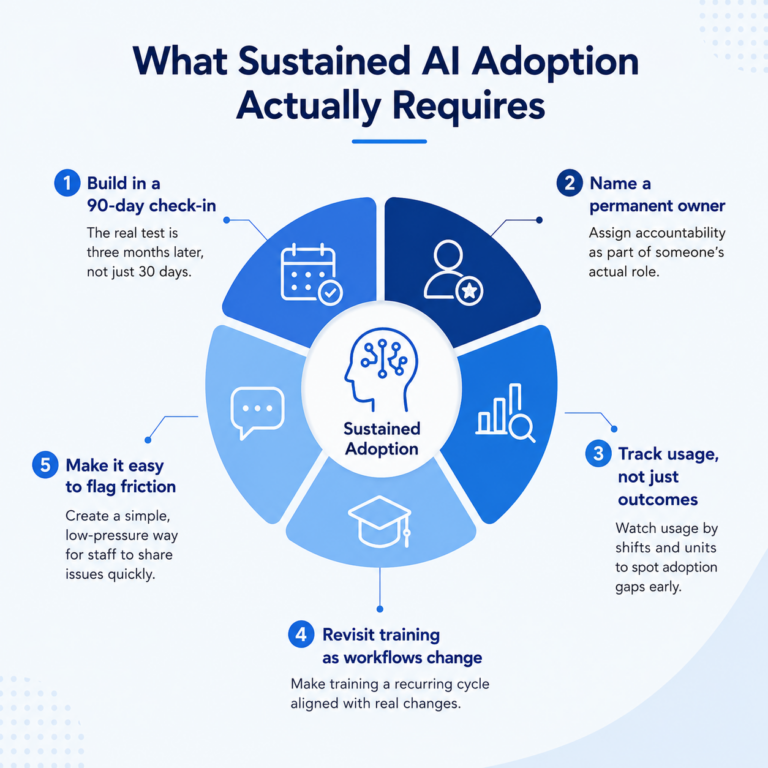
What Sustained AI Adoption Actually Requires
Sustaining adoption looks less like a launch event and more like ongoing maintenance, similar to how organizations already treat compliance or quality assurance.
Build in a 90-day check-in, not just a 30-day one. Most rollouts get evaluated too early, while enthusiasm is still high. The real test is three months later.
Name a permanent owner, not just a launch champion. Assign accountability for the tool’s ongoing use as part of someone’s actual role, not as a side project that quietly disappears when priorities shift.
Track usage, not just outcomes. Knowing that documentation time went down is useful. Knowing which shifts or units stopped logging in is more useful, because it tells you exactly where the culture is slipping before it becomes a bigger problem.
Revisit training as workflows change. New hires, new census patterns, and system updates all create quiet gaps in adoption. Treat training as a recurring cycle tied to real changes in the organization, not a one-time event tied to launch week.
Make it easy to flag friction. Staff who hit a snag with the tool need a fast, low-pressure way to say so. If the only feedback loop is a quarterly survey, small frustrations pile up until people just stop using the tool altogether.
What Does This Mean for Your Organization?
An AI-ready culture isn’t proven on launch day. It’s proven six months later, when the initial excitement has worn off and the tool is either woven into daily work or quietly abandoned. The organizations that get this right treat adoption as a living process worth checking on regularly, not a milestone to check off once and move on from.
If you want the fuller picture of how to build that readiness in the first place, our recent webinar walks through the framework in detail, along with real examples from senior living organizations navigating this exact challenge. Watch the AI Readiness webinar here.
And if you haven’t already, it’s worth revisiting our AI Readiness Checklist: 10 Key Questions before your next rollout. It’s a useful gut check for whether your organization is actually ready to sustain adoption, not just start it.